 Nerdy
Nerdy
Guiding Coalition
Change doesn't happen by org chart. It happens through a small group of people with the credibility and energy to pull others forward.
A guiding coalition is the group of people who actually make change happen. John P. Kotter named assembling one as among the earliest and most critical steps in any transformation, and he was specific about what it takes: positional power, expertise, credibility, and leadership. Read that as four seats to fill, not four adjectives describing a roster. The question isn’t whether your group is senior enough. It’s whether all four seats hold someone willing to spend something to keep them.
What Four Filled Seats Look Like
Our e-commerce platform engagement is a clean example. One portfolio, the services every other team depended on, had become the bottleneck for the entire company, with a Ruby on Rails core nobody remaining could maintain. The coalition that formed around it drew from four places:
- Positional power came from VPs on both sides of the house, product and engineering. Engineering authority alone could not have carried it: the bottleneck was a prioritization problem as much as a code problem.
- Expertise came from the principal engineers who knew the legacy code. They were the only people in the building who could say which capabilities to deprecate, which to hide behind a facade, and which to rewrite. Without them the platform strategy is a slide.
- Credibility came from the team managers whose teams mapped their own product development lifecycle and found the work piling up in their own pipeline. That’s why the first process changes landed as “we found this” rather than “leadership decreed this.”
- Leadership came from the core management team that ran the change like work instead of like an announcement: retrospectives at sprint boundaries, countermeasure experiments, a metric on each one.
Test your own group by pulling a seat and naming what breaks. With no positional power the coalition writes recommendations. With no expertise it picks the wrong first move confidently. With no credibility every change reads as something done to people. With no leadership the whole thing becomes a standing meeting that reports on itself.
How We Charter One
We start with Stakeholder Mapping, which sorts everyone touched by the change into Driving, Enrolled, Impacted, and Informed.
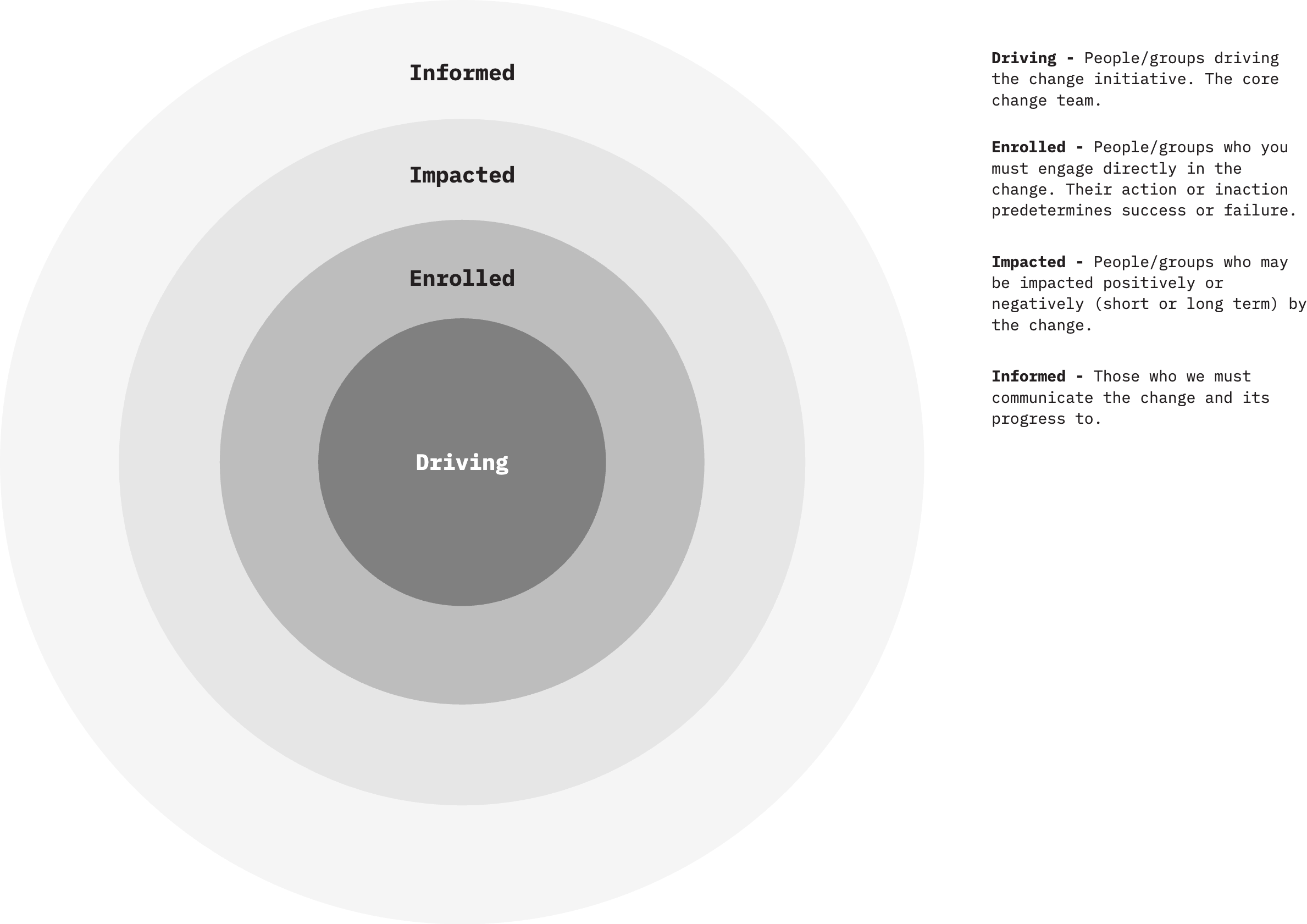
The coalition is the Driving ring. The argument worth having is who belongs in that ring and isn’t there yet. From there the group drafts the Change Vision itself, because a coalition that received a vision defends it until defending it costs something, and a coalition that wrote one defends it under pressure.
Then we treat the coalition as a team and give it a frame: a statement of purpose, objectives with success measures, working agreements, and a named community. The frame carries a time horizon and then expires, which forces the group to re-earn its own membership instead of quietly persisting.
Two Things That Aren’t a Coalition
Air cover isn’t a coalition. A single executive sponsor signs the budget, opens the all-hands, says “you have my full support,” and delegates. That’s useful, and it’s a different thing. Sponsorship gives you permission. A coalition gives you people who will spend their own political capital once the change starts costing their peers something. An engineering-only mandate on that platform work would have died the first time a committed roadmap collided with platform investment.
Assigned isn’t enrolled. Ask each function to send a representative and you get a roster, not a coalition. The tells are consistent. Members send a substitute when they’re busy. They report status instead of making decisions. They can’t tell you what their own group gives up in this change. Enrollment isn’t a calendar invite. It’s someone who can say what this costs them and shows up anyway.
Coalitions Drift
That platform coalition formed well and then ran too hot. Retrospectives at every sprint boundary generated so many process changes that the experiments blurred into the plan of record. Nothing looked broken from outside the group: they were engaged, meeting, shipping changes. The signal was quieter than that. Nobody could say which change had produced which result.
What re-anchored it was documenting the metric behind each change and putting a WIP limit on change itself. Fewer experiments in flight, each one attributable. The process stabilized considerably from there.
Drift is the normal state, not the failure case. Relentless Communication is how the coalition stays aligned with itself, not just how it talks outward, and Quick Wins are what let members justify the time to their own bosses. Both are maintenance, not launch activities.
A coalition whose members you can’t name is not a coalition. It’s a distribution list with a deadline.
Resources
- John P. Kotter, “Leading Change” (Harvard Business Review Press, 1996)
- Stakeholder Mapping — the activity for mapping who’s Driving, Enrolled, Impacted, and Informed
- Relentless Communication — how to keep the coalition aligned
- From Legacy Bottleneck to Modern Platform — the engagement the coalition above is drawn from